SUBSCRIBE
 GI RIGHTS HOTLINE
 CCW NEWSLETTER
 ON CONSCIENTIOUS OBJECTION


“We all have our own areas for action, and it is precisely there—and nowhere else—that we must choose whether to fuel the mentality of force … or to preserve the mindset of peace.”
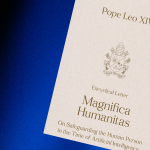
Pope Leo XIV writes these words in his first enclyclical letter, Magnifica Humanitas, and with them (and others) gives critical new foundational support for conscientious objectors in today’s military.
Conscientious objector applications are not simply declarations against war. It requires servicemembers to detail the development of a coherent moral philosophy. It asks them to identify the books, thinkers, religious teachings, experiences, and ethical principles that shaped their beliefs.
Pope Leo’s statements matter because they provide a contemporary, authoritative articulation of a moral framework that Catholics and even non-Christians alike may find persuasive as they examine their own conscience.
We are not dealing in hypotheticals. Last week, we attended a CO hearing with one of our clients who is Catholic. The hearing took place in the Middle East, as this soldier is currently forward deployed in “Operation Epic Fury,” refusing to carry a weapon in the combat zone.
“No One Is Without Responsibility”
We recently wrote about how Leo XIV and all three Popes who preceded him have questioned whether the Church’s “Just War Theory” is applicable in modern times, leading him to call on Iran war combatants to “lay down your arms” in his Easter homily.
But on June 6 he made a more decisive comment to reporters:
“The notion of a just war no longer applies. The problem is that Just War Theory developed in centuries when no one could have imagined the weapons we have today or humanity’s capacity for destruction.”
Just War Theory emerged in an age when wars were fought by armies marching on foot, communicating at the speed of horseback, and wielding weapons whose destructive power was measured in yards rather than continents. While ancient and medieval warfare could be brutal, it lacked the capacity for the instantaneous, industrial-scale destruction that characterizes modern conflict. Pope Leo XIV’s challenge is not merely to war itself, but that the moral principles developed for that earlier world cannot meaningfully regulate warfare in the age of drones, artificial intelligence, and nuclear weapons.
We have already entered an era of warfare that cannot be separated from the dominance of AI.
In fact, the US bombing of the Minab girls’ school killing 168 children–which was the single greatest reason given by servicemembers calling our hotline as what made them decide to file as COs–was conducted using the Pentagon’s AI targeting system “Project Maven.”
The Pope dedicated Chapter 5 of Magnifica Humanitas to AI and warfare. Much of it is useful for COs. While different passages of the encyclical will speak to different people, some jump out.
He writes how war conflicts with recognition of the equal dignity of all people:
“No algorithm can make war morally acceptable… Moral judgment cannot be reduced to calculation, for it involves conscience, personal responsibility and the recognition of the other as a person.”
He supports the idea that killing cannot be justified merely because a military system has designated someone as an enemy. He writes that this new military “reduces victims to data,” yet that does not “remove the intrinsic inhumanity of conflict.”
He declares we are on a path that “accustom[s] us to the idea that violence is inevitable and needs only to be optimized.”
But he also writes that individuals can change that:
“The civilization of love will not arise from a single or spectacular gesture, but from the sum total of small and steadfast acts of fidelity that serve as a bulwark against dehumanization.”
For conscientious objectors, their stand may seem small and personal. But they are undoubtedly, and quite powerfully, part of that sum total. Recognizing themselves as such can be an important addition to CO claims.
It is clear we are stepping into a new and dark future of warfare, which began with drones and has grown a terrifying new appendage we know as AI. Service members recognizing the implications for humanity have rights to opt out.
The Pope has helped them by lending a moral and philosophical authority to their beliefs. We have already seen Leo XIV quoted in new CO applications. Magnifica Humanitas offers so much more to these soldiers of conscience.
Expanding on the quote we began with: “we must choose whether to fuel the mentality of force … or to preserve the mindset of peace … No one is without responsibility.”